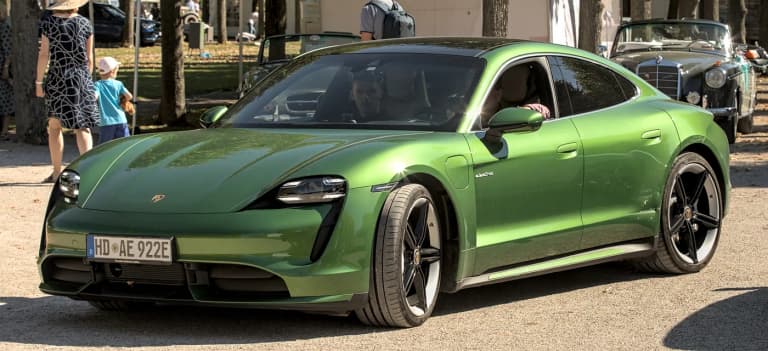
The Porsche Taycan is Porsche’s first all-electric production car, a four-door sports sedan launched in 2019 on the J1 platform. It runs an 800-volt electrical architecture that enables some of the fastest charging in the industry. Power ranges from roughly 400 horsepower in the base rear-wheel-drive car up to over 1,000 horsepower in the Taycan Turbo GT, the most powerful production Porsche ever made. A major 2024 update added more power, longer range, and faster charging across every trim.
In this article, we’ll go through the Porsche Taycan, Porsche’s electric sports sedan, trim by trim. We’ll cover the three body styles, EPA range, 320 kW charging, and pricing.
Contents
- 1 Quick Summary
- 2 Porsche Taycan Overview: Platform, Power, and Purpose
- 3 Taycan Body Styles: Sedan, Sport Turismo, and Cross Turismo
- 4 Taycan Trim Levels: Base to Turbo GT
- 5 The 2024 Porsche Taycan Update: Power, Range, and Charging
- 6 Taycan Range and Charging Speed
- 7 Taycan Performance: 0-60 Times and Track Records
- 8 Driving the Taycan: Handling, Dynamics, and 800V Architecture
- 9 Taycan Interior: Cabin Quality, Tech, and Practicality
- 10 Porsche Taycan vs Tesla Model S: Performance, Charging, and Feel
- 11 Porsche Taycan Pricing: New and Used
- 12 Taycan Ownership: Reliability and Running Costs
- 13 Frequently Asked Questions
Quick Summary
- What it is: Porsche’s first electric production car, a four-door sports sedan on the J1 platform since 2019
- Trim range: base RWD at around 400 hp up to the Turbo GT at 1,019 hp, the quickest-accelerating production Porsche ever built
- Charging: 800-volt architecture peaks at 320 kW, going from 10 to 80 percent in about 18 minutes after the 2024 update
- Range: GTS leads the lineup at up to 330 miles EPA; the Turbo and Turbo S trade range for power
- Body styles: Sedan, Sport Turismo wagon, and Cross Turismo with a raised ride height and cladding
- Best pick: the GTS is the sweet spot for performance and range; the 4S is the value pick
- Pricing: starts around $103,300 for the base sedan, up to about $232,000 for the Turbo GT
- Reliability: early cars had some software and electrical niggles, but the drivetrain itself has proven solid
Porsche Taycan Overview: Platform, Power, and Purpose
The Porsche Taycan is Porsche’s first series-production electric car. It arrived in 2019 as a low, four-door sports sedan built on the J1 platform, a bespoke electric architecture Porsche developed jointly with Audi. The Audi e-tron GT shares the same underpinnings, but the tuning, the software, and the character of the two cars are distinctly different.
The name comes from a Turkic word roughly meaning “young wild horse,” and it was chosen to signal that this was not a compliance car. Porsche’s stated goal was to make an electric car that drives the way a Porsche should. The Taycan largely delivered on that. It earned praise from reviewers not just for its performance numbers but for the sense of engagement it preserves despite the move to electric power.
The Taycan sits below the Porsche Panamera in overall size and competes against the Audi e-tron GT, Mercedes EQS AMG, and Tesla Model S. It is positioned as a pure performance vehicle rather than a luxury barge, and that distinction is felt immediately in how it drives.
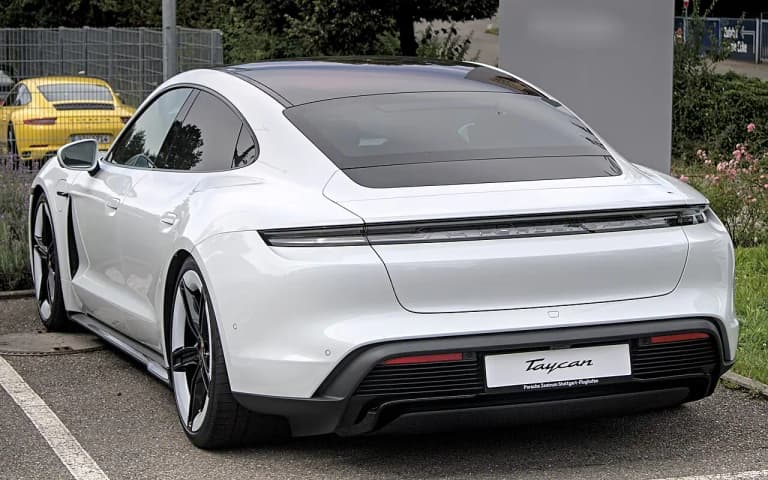
Porsche launched the Taycan alongside its combustion cars, not as a replacement for them. The strategy was deliberate: prove that an electric Porsche could be just as rewarding as a petrol one, then use that technology to electrify the rest of the lineup. The electric Porsche Macan now builds directly on what the Taycan established.
Taycan Body Styles: Sedan, Sport Turismo, and Cross Turismo
The Taycan is available in three body styles. All share the same J1 platform, the same powertrain options, and the same trim levels. The choice of body comes down to how much space you need and how you want the car to look.
Porsche Taycan Sedan
The original body is a low four-door sedan with a fastback roofline. It is the sleekest of the three and the most sporting in character. The sedan has a frunk (front trunk) under the hood plus a rear luggage area, though the low roofline limits rear headroom for taller passengers. This is the body most buyers choose, and it is the one Porsche photographs on track.
Porsche Taycan Sport Turismo
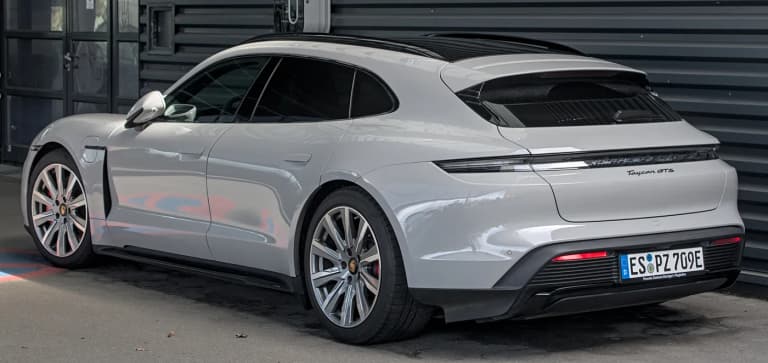
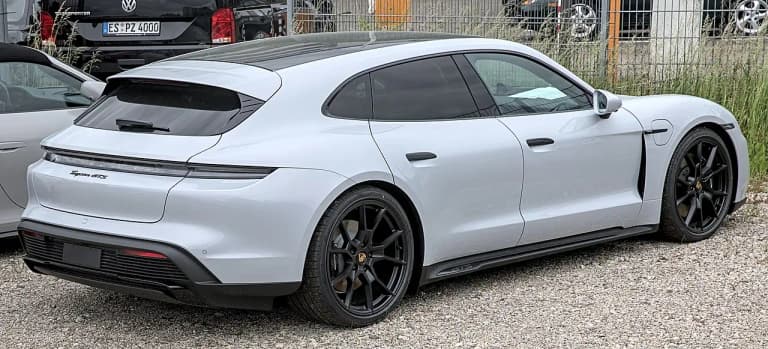
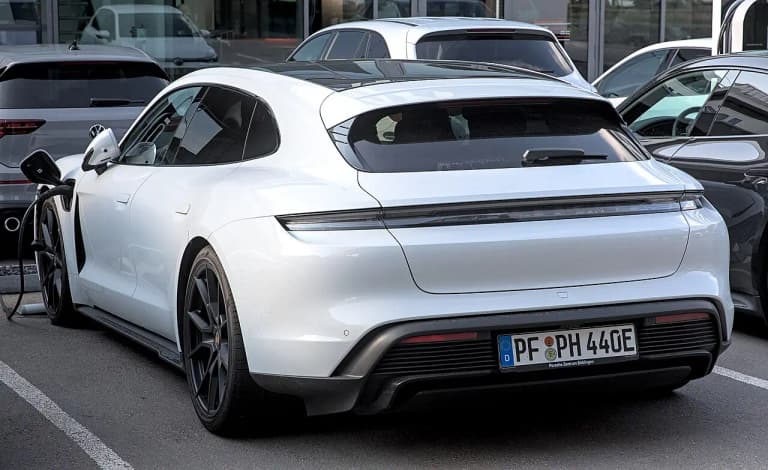
Added in 2021, the Sport Turismo is a shooting-brake estate variant. The roofline extends further back before dropping, which gives meaningfully more rear headroom and a larger cargo area than the sedan. The Sport Turismo rides at the same height as the sedan and drives identically. It is the more practical daily car without sacrificing any driving dynamics.
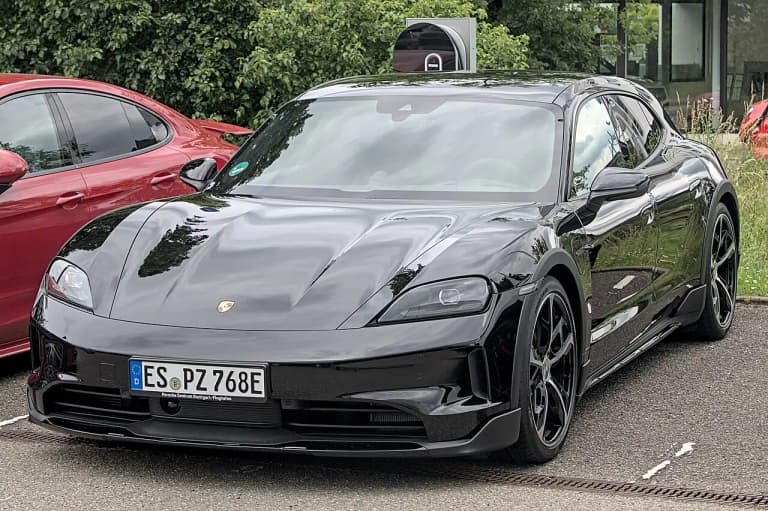
Porsche Taycan Cross Turismo
The Cross Turismo also arrived in 2021. It uses the same Sport Turismo wagon body but adds a slightly raised ride height, body cladding around the wheel arches and sills, and a standard air suspension setup. It is the most practical of the three, and it has mild off-road ability that the others lack. If you need a Taycan that can handle gravel driveways and light dirt roads, this is the one.
Taycan Trim Levels: Base to Turbo GT
The Taycan runs from a rear-wheel-drive base car all the way to the 1,000+ horsepower Turbo GT. Every trim from the 4S up is all-wheel drive. Power figures are the overboost output with launch control active, which is how Porsche quotes the headline numbers across its lineup. These figures apply to the updated 2024 model year cars.
| Trim | Drive | Peak Power | 0-60 mph | Top Speed | EPA Range |
|---|---|---|---|---|---|
| Taycan | RWD | ~400 hp | 4.5 sec | 143 mph | up to 318 mi |
| Taycan 4S | AWD | 590 hp | 3.3 sec | 155 mph | up to 315 mi |
| Taycan GTS | AWD | 690 hp | 3.1 sec | 155 mph | up to 330 mi |
| Taycan Turbo | AWD | 871 hp | 2.5 sec | 162 mph | 292 mi |
| Taycan Turbo S | AWD | 938 hp | 2.3 sec | 162 mph | 266 mi |
| Taycan Turbo GT | AWD | 1,019 hp | 2.1 sec | 190 mph | ~230 mi |
Taycan (Base, Rear-Wheel Drive)
The base Porsche Taycan is rear-wheel drive, which makes it the most unusual car in the lineup. A single motor drives the rear axle. With the smaller Performance Battery it makes around 300 horsepower; the Performance Battery Plus pushes that to around 400 horsepower in overboost. The result is a 0-60 time of around 4.5 seconds, which is fast for most purposes but considerably slower than the all-wheel-drive cars.
The base car is also the longest-range Taycan when equipped with the large battery and the standard-output motor configuration. It earns up to 318 miles on the EPA cycle. If maximum range matters more to you than maximum acceleration, this is the trim to consider.
Taycan 4S
The Taycan 4S is the first all-wheel-drive trim and the starting point for most buyers. It adds a second motor on the front axle, bringing power to 590 horsepower in overboost and dropping 0-60 to 3.3 seconds. The 4S is meaningfully quicker than the base car without reaching the price level of the GTS or Turbo. See our full Taycan 4S guide for the deep dive.
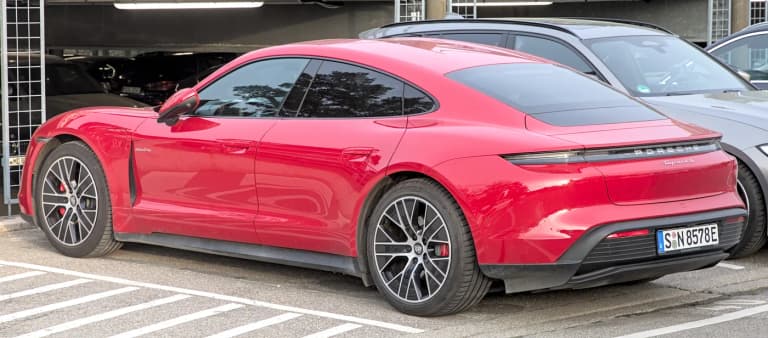
The 4S represents strong value in the Taycan lineup because it shares the same platform, the same high-quality cabin, and the same 800-volt charging architecture as the more expensive trims. The performance gap versus the GTS is real but not dramatic in everyday driving.
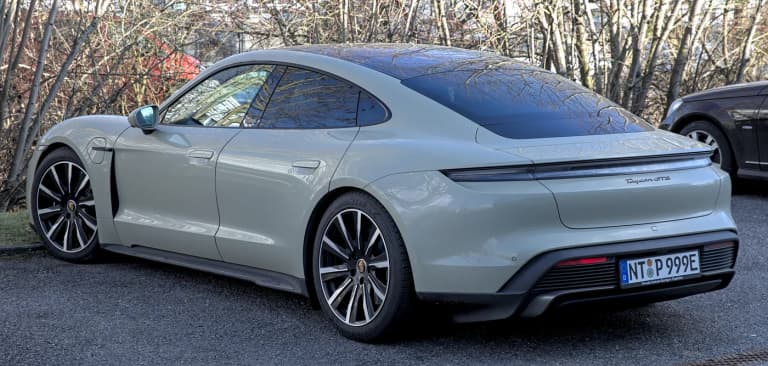
Taycan GTS
The Taycan GTS is the sweet spot. It makes 690 horsepower in overboost, runs 0-60 in 3.1 seconds, and crucially has the longest range in the entire lineup at up to 330 miles. That combination of near-Turbo performance with the best range is unusual, and it makes the GTS the trim Porsche enthusiasts most often recommend.
The GTS also gets sport-specific tuning, lower suspension than the 4S, black exterior trim, and Alcantara throughout the interior. It has a distinct character compared to the more comfort-focused Turbo. If you want the Taycan that drives the sharpest and goes the furthest on a charge, the GTS is the answer.
Taycan Turbo
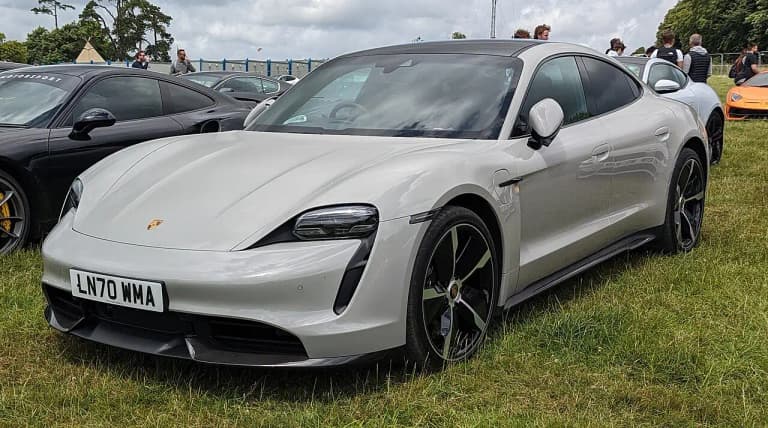
The Taycan Turbo makes 871 horsepower in overboost and hits 60 mph in 2.5 seconds. It gets a larger front motor than the GTS, a more aggressive tune, and a standard air suspension that can be adjusted between comfort and sport modes. The Turbo also gets more equipment as standard, including a larger curved display and more advanced chassis technology.
Range drops to 292 miles with the Turbo, a real-world consequence of the more powerful motors and heavier hardware. That is still a usable number for most buyers, but the gap versus the GTS is notable if range matters to you.
Taycan Turbo S
The Taycan Turbo S takes everything up another level. Peak output reaches 938 horsepower in overboost and 0-60 drops to 2.3 seconds. The car also gets larger motors, a more aggressive cooling system, and the highest standard equipment specification in the sedan lineup. The Turbo S is for buyers who want the most capable everyday Taycan without going full track-weapon with the Turbo GT.
EPA range falls to 266 miles on the Turbo S, a consequence of the larger motors and the increased thermal demands at high performance levels.
Taycan Turbo GT
The Taycan Turbo GT is in a different class entirely. It produces 1,019 horsepower with launch control active and can reach brief overboost peaks near 1,100 horsepower. According to the Porsche Newsroom, it runs 0-60 in 2.1 seconds and has a top speed of 190 mph, making it the quickest-accelerating production Porsche ever built.
In 2024 the Turbo GT set a new production EV lap record at the Nurburgring Nordschleife: 7 minutes 7.55 seconds. It also set a Laguna Seca record of 1 minute 27.87 seconds that year. An optional Weissach Package removes the rear seats, adds a carbon fiber roll cage structure and carbon ceramic brakes, and drops weight to sharpen the track focus further. This is not a comfortable long-distance car. It is a track weapon that happens to carry four people.
The 2024 Porsche Taycan Update: Power, Range, and Charging
Porsche launched an extensive update to the Taycan in early 2024, covering almost every dimension that matters: power, range, charging, and technology. If you are shopping used, the pre-2024 cars are meaningfully different from the updated ones. Understanding the gap helps you decide whether to pay the premium for a post-2024 car or accept the tradeoffs on an older one.
Power and Performance Gains
Every trim received a power increase in the 2024 update. New permanent-magnet synchronous motors at both axles replaced the previous rear induction motor, which improved both peak output and efficiency. The GTS, for example, went from 590 to 690 horsepower. The Turbo S grew from 750 to 938 horsepower. These are not small bumps; they represent a genuine generational step in the Taycan’s performance capability.
The two-speed transmission on the rear axle was already present in the original Taycan and carried over to the update. It is one of the few electric cars in the world with a multi-speed gearbox, and it is part of what gives the Taycan its unique high-speed refinement. At low speeds, first gear maximizes acceleration. At high speed, second gear keeps the motors in their efficient operating range.
Range Improvements
The 2024 update brought the single biggest jump in range the Taycan has seen. A revised battery chemistry in the Performance Battery Plus improved energy density, and the more efficient new motors reduced consumption at cruising speeds. The GTS saw its EPA range climb by as much as 35 percent over early cars. The base rear-wheel-drive Taycan now reaches 318 miles, a number that would have been extraordinary for this size of vehicle just a few years ago.
Faster Charging
Peak DC fast charging jumped from 270 kilowatts on the original to 320 kilowatts on the updated car. That is a significant number, and the real-world benefit is noticeable: the 10-to-80-percent charge now takes roughly 18 minutes under good conditions, versus around 30 minutes on the pre-2024 cars. AC home charging also improved, with a standard on-board charger that handles 11 kilowatts (or an optional 22 kilowatt version in markets where that infrastructure exists).
Taycan Range and Charging Speed
EPA Range by Trim
The EPA range figures below are for the updated 2024 model year Taycan sedan. Sport Turismo and Cross Turismo variants are within a few miles of these numbers in most trims. All use the Performance Battery Plus unless noted.
| Trim | EPA Range | Battery |
|---|---|---|
| Taycan (base, small battery) | up to 242 mi | Performance Battery |
| Taycan (base, large battery) | up to 318 mi | Performance Battery Plus |
| Taycan 4S | up to 315 mi | Performance Battery Plus |
| Taycan GTS | up to 330 mi | Performance Battery Plus |
| Taycan Turbo | 292 mi | Performance Battery Plus |
| Taycan Turbo S | 266 mi | Performance Battery Plus |
Real-world range is typically 10 to 20 percent below EPA numbers at highway speeds. In cold weather, range can fall further. The GTS leads on range because Porsche tuned its motors for a balance of performance and efficiency. The Turbo and Turbo S prioritize raw output over economy, and the range numbers reflect that trade-off.
Charging Speed
The 800-volt architecture is what makes the Taycan’s charging performance exceptional. At 800 volts, the same power level means half the current compared to a 400-volt car, which produces less heat and allows the charging system to sustain its peak rate for longer.
On a 350-kilowatt DC fast charger, the updated Taycan reaches its 320-kilowatt peak and can add around 100 miles of range in about 10 minutes. The 10-to-80-percent charge completes in roughly 18 minutes. For reference, a Tesla Model S Plaid charges at a peak of around 250 kilowatts on Supercharger V3, and the Audi e-tron GT peaks at 270 kilowatts. The Taycan is the fastest-charging car in its competitive set.
AC home charging runs at 11 kilowatts standard (or 22 kW optional), which means a full charge from a wallbox takes around 9 to 10 hours overnight. Level 2 charging at 7.2 kilowatts takes longer, around 13 hours for a full charge from empty.
Taycan Performance: 0-60 Times and Track Records
0-60 mph Times by Trim
The Taycan’s 0-60 times represent the overboost figures with launch control active. In normal Sport Plus mode without launch control, the times are slightly slower but still extremely quick. The overboost function draws extra energy from the battery for a set number of seconds, giving a brief power peak that the sustained rating cannot maintain.
The Taycan Turbo GT’s 2.1-second 0-60 time is among the quickest ever recorded for a production four-door car. For comparison, a Porsche 911 Turbo S hits 60 in around 2.6 seconds. The Taycan Turbo GT is measurably faster in a straight line than Porsche’s own 911 Turbo S, which would have been an implausible statement before electric powertrains arrived.
Nurburgring and Track Records
The Taycan Turbo GT set a production electric car lap record at the Nurburgring Nordschleife of 7:07.55 in 2024. This bettered the previous EV record and placed it ahead of many high-performance combustion cars on the same circuit. The Laguna Seca record of 1:27.87 was set in the same year.
These records were set in production-specification cars with the optional Weissach Package. The Weissach Package removes the rear seats, adds carbon ceramic brakes, and installs carbon fiber composite components throughout the structure to reduce weight. It does not alter the engine tune or the peak power output; the time savings come from reduced mass and better stopping performance.
Driving the Taycan: Handling, Dynamics, and 800V Architecture
Chassis and Handling
The Taycan drives like a sports car first and an electric car second. The battery pack sits under the floor of the cabin, giving the car a very low center of gravity that a combustion car with an engine over the front axle simply cannot match. Combined with the weight spread evenly between the front and rear axles, the result is a car that feels balanced and neutral in corners.
Porsche tuned the suspension to be firm without being uncomfortable. The standard Taycan has passive dampers; the GTS and above come with air suspension as standard, which can raise the ride height for parking or lower it for track work. In Sport mode, the GTS air suspension is noticeably more compliant than older performance cars at the same level. It still communicates what the road is doing through the wheel.
Steering is electrically assisted and weighted on the heavier side of the spectrum. It does not have the direct feel of a 911, but it is better than most electric cars. Porsche’s rear-axle steering system, standard on the GTS and Turbo variants, reduces the turning radius at low speeds and improves stability at high speed. It makes the car feel shorter than it is in tight parking lots and more planted on motorway on-ramps.
Why the 800-Volt System Matters
The 800-volt electrical architecture is not just a charging headline. It affects the car’s performance in two meaningful ways. First, the higher voltage means lower current for the same power delivery, which generates less heat in the wiring and motors. That allows the car to sustain its peak output for longer without thermal throttling, which is a problem that limits some competing electric cars in repeated hard acceleration runs.
Second, the 800-volt system enables the unique two-speed rear transmission. The gearbox allows the rear motor to stay in its most efficient operating band across a wide speed range, contributing to both performance consistency and range at higher cruising speeds. It is one of the technical reasons the Taycan still feels quick at 100 mph when some competing EVs have clearly run out of their best power band.
Taycan Interior: Cabin Quality, Tech, and Practicality
The Taycan’s cabin is one of the best interiors Porsche has produced. The dashboard is low and horizontal, giving a wide open feeling despite the relatively narrow body. Build quality is excellent throughout, with materials that feel genuinely premium rather than just visually convincing.
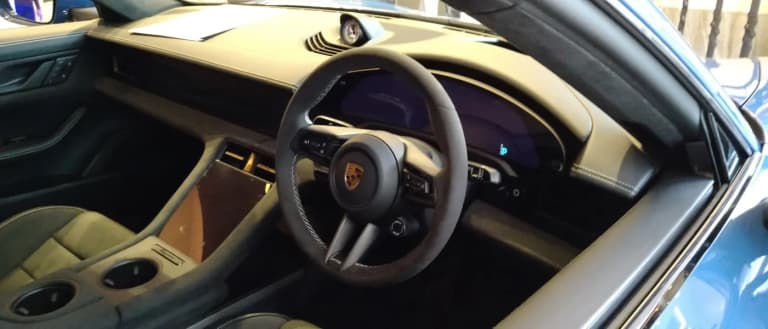
The 2024 update brought a redesigned center console with physical controls for climate and drive mode functions, addressing a common criticism of the original’s all-touchscreen approach. The main driver display is a 16.8-inch curved panel that integrates the instrument cluster and the infotainment system in one sweep of glass. An optional 10.9-inch passenger display allows the front passenger to browse or watch video content while the car is moving.
Infotainment and Technology
The Porsche Communication Management system handles navigation, media, and vehicle settings. It is fast, logically laid out, and integrates wireless Apple CarPlay and Android Auto. Route planning takes the battery state into account and suggests charging stops for longer journeys. The system updates over the air, which means the car can gain new features after purchase.
Standard driver assistance includes adaptive cruise control, lane keeping assist, and a surround-view camera. The Taycan also supports Porsche’s Track Precision app, which records telemetry during track sessions and overlays it on video footage for analysis. This is the same functionality that appears on the track-focused combustion Porsches, and its inclusion on the Taycan reflects the car’s genuine performance intent.
Rear Seat Space and Practicality
The sedan’s rear seat is usable for adults up to around 6 feet tall. Taller passengers will find the sloping roofline limits headroom over longer journeys. Legroom is reasonable for the class. The Sport Turismo and Cross Turismo bodies add meaningful headroom, and they are the recommended choices for buyers who plan to regularly carry rear-seat passengers.
Cargo space in the sedan is modest: around 16 cubic feet in the rear and a useful front trunk under the hood. The Sport Turismo adds a proper cargo floor with a power tailgate and around 40 cubic feet with the rear seats folded. The Cross Turismo matches those numbers with the slight addition of a longer load floor due to its raised body.
Porsche Taycan vs Tesla Model S: Performance, Charging, and Feel
The Tesla Model S and the Porsche Taycan are the two cars buyers most often compare at this price and performance level. They are genuinely different in their approach, and the right choice depends on what matters to you.
The Model S Plaid is faster in a straight line. Its tri-motor setup produces 1,020 horsepower and has run 0-60 in the low 1.9-second range under perfect conditions. The Taycan Turbo GT is comparable at 2.1 seconds, but the Plaid has a power-to-cost advantage since it starts considerably lower.
The Taycan wins on charging speed, on driving feel, and on build quality. The 800-volt system’s 320-kilowatt peak charging is comfortably ahead of the Supercharger V3’s 250 kilowatts for the Model S. On a winding road, the Taycan’s chassis calibration and mechanical engagement are clearly better. The Tesla is an impressive device; the Porsche is an impressive car. Those are different things, and experienced drivers tend to prefer the Taycan once they have driven both.
Tesla’s Supercharger network is a genuine advantage in North America for coverage and reliability. Porsche drivers must use third-party networks like Electrify America for DC fast charging, which is improving but not yet at Tesla’s consistency level.
Porsche Taycan Pricing: New and Used
New Taycan Prices
Porsche Taycan pricing for the 2025 model year in the United States starts at around $103,300 for the base rear-wheel-drive sedan. The 4S starts at around $120,300. The GTS lists from approximately $134,700. The Turbo begins at around $175,900. The Turbo S starts near $212,000. The Taycan Turbo GT lists from approximately $232,000 before options.
These prices move with the model year, and Porsche’s options list adds up quickly. Items like the sport chrono package, rear-axle steering, matrix LED headlights, premium audio, and seat heating can add $15,000 or more to any trim’s sticker. A well-optioned Turbo S can cross $250,000.
Sport Turismo and Cross Turismo body styles carry a small premium over the equivalent sedan trim, typically around $5,000 to $7,000 depending on configuration.
Used Taycan Prices
The used Taycan market has softened since the 2024 update made older cars less competitive on range and charging. A pre-2024 Taycan 4S can often be found in the $80,000 to $100,000 range with reasonable mileage. The original Turbo and Turbo S have dropped more sharply, with some early examples available near $100,000 to $130,000.
When shopping used, the key things to check are battery health (ask for a diagnostic read of the State of Health), the charging history (frequent DC fast charging above 80 percent accelerates degradation slightly), and whether the car has had any software recalls applied. Buying from a Porsche Approved Certified Pre-Owned source gives a warranty that covers the high-voltage battery and drivetrain, which is worth the premium over a private purchase.
Taycan Ownership: Reliability and Running Costs
Reliability
Early Taycan owners reported some first-generation issues, mainly around software bugs, occasional charging anomalies, and minor electrical gremlins. These are typical of any first-generation EV and were largely addressed through over-the-air updates. The physical drivetrain, the high-voltage battery, and the structural components have held up well in owner reports over five-plus years of production.
The 2024 update cars have a much shorter track record in owners’ hands, but the platform is mature and the changes were evolutionary rather than a ground-up redesign. Early reports on updated cars are positive. Consumer reports for the Taycan have generally improved year over year as the software has matured.
Maintenance and Running Costs
An electric drivetrain removes several of the recurring costs a combustion Porsche carries. There are no oil changes, no spark plugs, no timing chains, and no clutch or gearbox oil on the main drive units. The two-speed rear transmission has its own fluid that Porsche recommends changing on a schedule, but the interval is long.
Brake wear is reduced by regenerative braking, which handles most routine deceleration without touching the friction pads. Brake fluid still needs periodic replacement. Tires are the main consumable cost on a Taycan. The car’s weight (around 5,100 pounds for a Turbo) and the instant torque delivery accelerate wear on the rear tires in particular. Expect to replace rear tires more often than on a lighter car.
Electricity costs depend heavily on local rates. Charging at home on a standard overnight plan costs a fraction of what a comparable petrol car would spend on fuel. DC fast charging costs more but is still typically below petrol parity for the equivalent range. Annual maintenance costs for a Taycan are lower than for a comparable Porsche combustion model, which partially offsets the higher purchase price.
Porsche’s warranty in the United States covers the vehicle for 4 years and 50,000 miles, with the high-voltage battery warranted for 8 years and 100,000 miles against defects and capacity falling below a defined threshold. This battery warranty is meaningful for a used buyer because it transfers with the car.
Frequently Asked Questions
Is the Porsche Taycan a good car?
Yes. It is widely rated as one of the best-driving electric cars on sale. The handling, the build quality, and the sense of engagement it preserves despite the electric drivetrain set it apart from most competitors. The 800-volt system gives it some of the fastest charging in the class, and the 2024 update significantly improved range across every trim.
Why is the Taycan called Turbo if it is electric?
There is no turbocharger. Porsche uses Turbo and Turbo S as trim-level names to indicate the most powerful versions, the same way it does on the combustion models. It is marketing continuity rather than a technical description.
How far can a Porsche Taycan go on a charge?
After the 2024 update, the GTS leads the lineup at up to 330 miles on the EPA cycle. The base rear-wheel-drive car reaches up to 318 miles. The Turbo and Turbo S trade range for performance, reaching 292 and 266 miles respectively. Real-world range at highway speed and in cold weather is typically 10 to 20 percent below these figures.
How fast does the Porsche Taycan charge?
The updated Taycan peaks at 320 kilowatts on a DC fast charger and can go from 10 to 80 percent in roughly 18 minutes. That is the fastest charging in the electric sedan class. At home on an 11-kilowatt AC wallbox, a full charge takes around 9 hours.
Which Porsche Taycan should I buy?
The GTS is the right answer for most buyers: near-Turbo performance, the longest range in the lineup, and GTS-specific sport tuning and interior treatment. The 4S is the value pick if you want to spend less without giving up the 800-volt platform or AWD traction. The Turbo GT is for buyers who want the most extreme version and plan to use a track.
Is the Porsche Taycan reliable?
Early cars had some software and minor electrical issues. The drivetrain itself has been solid. Post-2024 cars have the benefit of a mature platform and improved hardware. Buying from a certified pre-owned source with a Porsche warranty is strongly recommended for used buyers. The battery is covered for 8 years and 100,000 miles against defects and significant capacity loss.
Images: Taycan Turbo (hero), Taycan 4S, Taycan GTS, and Cross Turismo GTS by Alexander-93, CC BY-SA 4.0. Taycan interior by Aos.1905, CC BY 4.0. 2024 Taycan white and Sport Turismo 2024 by Alexander-93, CC BY-SA 4.0. Taycan Turbo S 2020 by Calreyn88, CC BY-SA 4.0. Sport Turismo GTS (rear) and Sport Turismo GTS charging by Alexander Migl, CC BY-SA 4.0. Via Wikimedia Commons.