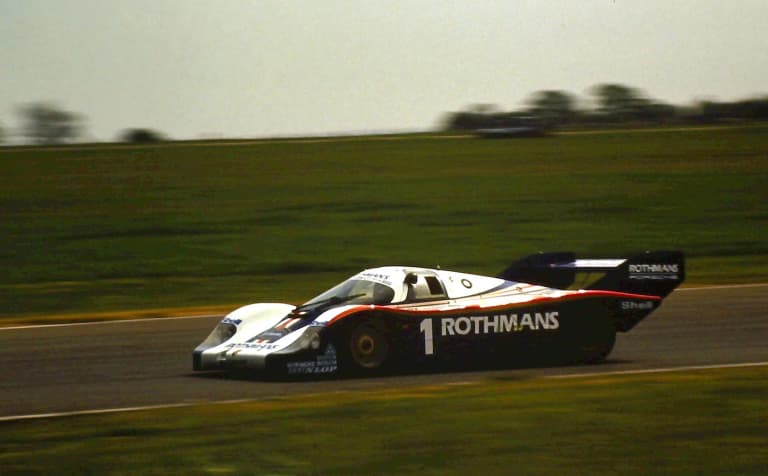
The Porsche 956 was Porsche’s first Group C prototype, the 1982 racing car that brought ground-effect aerodynamics into its endurance program. It swept the Le Mans podium that year, kept winning through 1985, and led directly to the Porsche 962.
In this article, we’ll explain the Porsche 956’s engineering and racing legacy. We’ll cover ground effects, Le Mans victories, and the 962 link.
Contents
Quick Summary
- Debut: 1982, Porsche’s first car built for the new Group C category.
- Engine: 2,649 cc turbocharged flat-six making 456 kW (620 PS).
- Top Speed: 360 km/h.
- Aerodynamics: A specially shaped underfloor created ground effect, the first time Porsche raced with it.
- Le Mans 1982: Works 956s finished 1-2-3 on the car’s first attempt at the race.
- Fuel Rules: In 1,000-kilometer races, a 100-liter tank and five permitted refueling stops made efficiency part of the strategy.
- Privateer Era: Joest’s 956B won Le Mans during the 1984 works boycott, then beat Porsche’s works 962Cs in 1985.
- Successor: The Porsche 962, built to satisfy American IMSA safety rules.
What Was the Porsche 956
The Porsche 956 is the racing car Porsche built for the 1982 season to compete in the new Group C category of endurance racing. It was a closed-cockpit sports prototype, and it turned out to be one of the most important cars the company has ever raced. You can see the full specification sheet on the Porsche Museum’s press kit.
What made the 956 stand out was not one single number. It was the whole package: ground-effect aerodynamics, a strong but light chassis, and an engine tuned to balance power against fuel use. That combination is what separated it from every prototype Porsche had raced before, including the 917 a decade earlier.
Why Porsche Needed a New Racing Car
Endurance racing changed for 1982. The FIA introduced Group C, a category built around fuel economy rather than unlimited engine capacity. Manufacturers now had to balance speed with consumption instead of simply chasing horsepower. Porsche explains that shift in its early Group C history.
A racing car that could go fast and go far on limited fuel was a genuinely new engineering problem. Porsche solved it by leaning on aerodynamics to generate grip instead of relying purely on engine output, which is the idea at the heart of the whole car.
The Technical Package: Ground Effect and the Flat-Six
The 956 combined a floor shaped to generate downforce with a compact turbocharged engine. Porsche could tune that engine for outright speed or fuel economy, depending on what a race required.
Ground-Effect Aerodynamics and the Aluminum Monocoque
The defining feature of the 956 was its ground effect aerodynamics. A specially shaped underfloor created downforce beneath the car and reduced its reliance on larger wings. It was the first time Porsche had raced a car built this way, and it helped the 956 carry speed through fast corners.
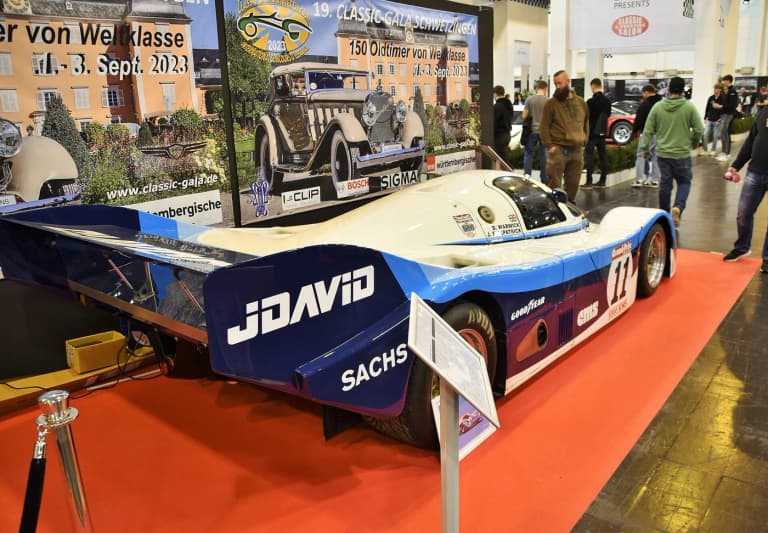
That aerodynamic floor sat beneath an aluminum monocoque chassis, a lightweight structural tub rather than a traditional tube frame. Porsche combined the stiff chassis and downforce-generating floor into one package designed for the new Group C rules.
The Turbocharged Flat-Six
Power came from a 2,649 cc turbocharged flat-six mounted behind the driver, producing 456 kW, or 620 PS. That was enough to push the 956 to a top speed of 360 km/h on the long straights at Le Mans, according to the Porsche Museum’s specifications.
Group C made fuel use as important as maximum power. Porsche therefore had to make the turbocharged engine fast enough to compete while keeping its consumption inside the race allowance. That balance, rather than the peak-power figure alone, explains why the engine suited the 956.
Fuel Strategy: Racing Inside Group C’s Rules
Group C’s fuel regulations shaped how the 956 was raced. For a 1,000-kilometer championship event, Porsche says the car had a 100-liter tank and five permitted refueling stops. That placed a hard ceiling on consumption. Le Mans used a separate allowance for its 24-hour format, so those 1,000-kilometer figures should not be carried across to that race.
At Le Mans, drivers watched a fuel-consumption gauge and used techniques such as lifting off the throttle early to stretch a stint without giving away an entire lap’s pace. Porsche explains that strategy in its account of the Group C program.
The 956 also became a test bed for another Porsche engineering project. Porsche says its PDK dual-clutch transmission was first used in racing for testing at Imola in 1984. Our Porsche PDK guide follows the system from racing development to road cars.
The 1982 Debut and Le Mans
The 956’s first season ended with one of Porsche’s strongest debut campaigns. Its headline result came at the 24 Hours of Le Mans.
A Competitive Debut at Silverstone
The 956 made its competitive debut at the 1982 Silverstone 6 Hours and won the Group C category. That result set up its first major test a few weeks later at Le Mans. Porsche tells the fuller story in its endurance racing legend feature.
Le Mans 1982: A 1-2-3 Sweep
At the 1982 24 Hours of Le Mans, works Porsche 956s finished first, second, and third on the car’s first attempt at the race. The official organizer’s account of that 1982 hat trick records the complete podium sweep.
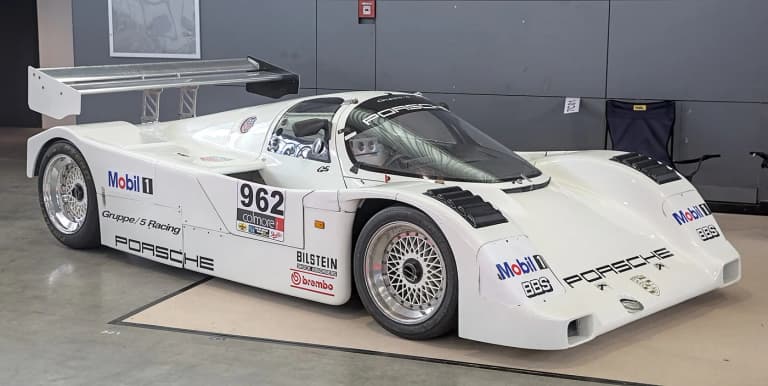
That kind of result on debut does not happen by accident. It confirmed that the ground-effect floor, the aluminum monocoque, and the tunable turbo flat-six were not just clever ideas on paper. They worked together as a complete racing car from the very first race weekend.
Customer 956B and the 1983 to 1985 Record
The 956 did not stay a factory-only project for long. Porsche sold updated 956B versions to privateer teams, and those customer cars kept winning after the works effort moved on. Porsche documents that development in its milestones and developments history.
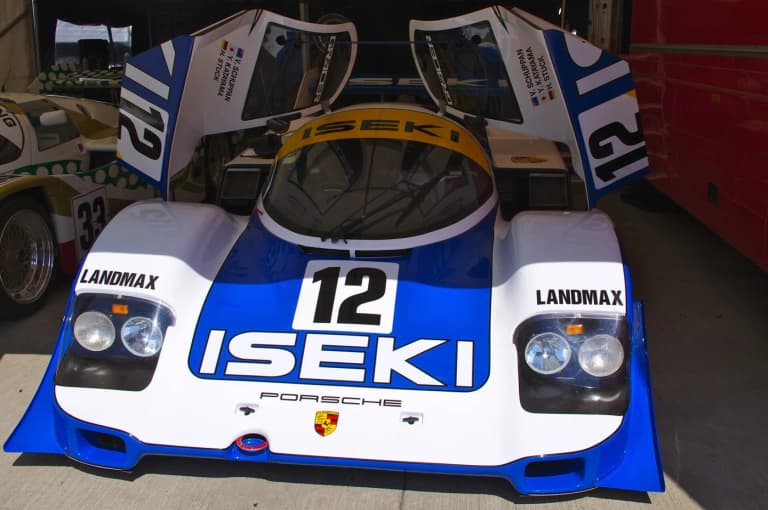
Bellof’s Nordschleife Lap
The 956’s capability was on full display away from Le Mans as well. During qualifying for the 1983 1,000-kilometer Nürburgring race, Stefan Bellof recorded a 6 minute 11.13 second Nordschleife lap. It later took a heavily derestricted 919 Hybrid Evo to beat that benchmark more than three decades later.
The 1984 Works Boycott and Joest’s Wins
A works 956 won Le Mans again in 1983. Porsche’s factory team then boycotted the 1984 race, but Joest Racing won with a privateer 956B. Joest won again in 1985, this time beating Porsche’s works 962Cs. Those results proved that customer teams could keep the design competitive.
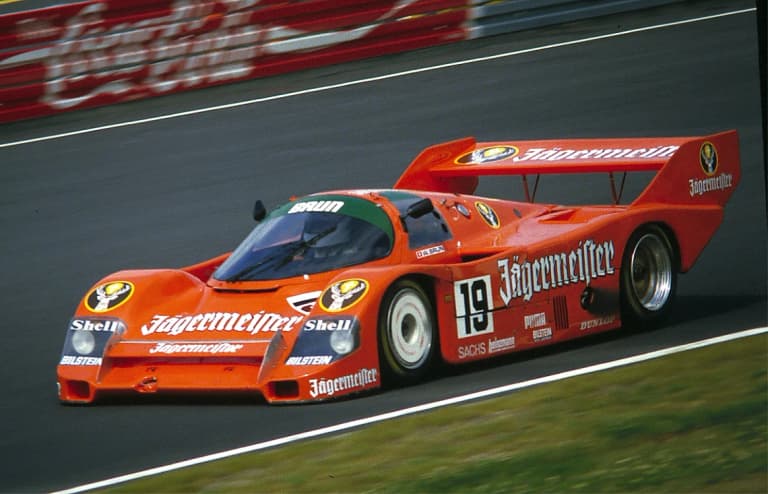
Between the works result and the privateer wins, the 956 and 956B won Le Mans every year from 1982 through 1985. Porsche’s history of the 956 records that four-year run, split between the factory team and Joest Racing.
956 vs 962: What Changed and Why
The 962 exists because of an American safety rule, not because the 956 needed fixing. IMSA did not permit the driver’s feet to sit ahead of the front axle, so the 956 could not compete under its rules.
Porsche moved the front axle about 12 cm forward, placing the driver’s feet behind the axle line and lengthening the car. That change produced the 962 for IMSA competition while retaining the 956’s basic aluminum-monocoque and ground-effect layout.
Our Porsche 962 guide covers the later car’s engine variants, Le Mans wins, and the privateer teams that raced it into the 1990s.
Why the 956 Matters
The 956 mattered because it showed how speed and fuel efficiency could work together under rules designed to reward both. Porsche combined ground effect, a lightweight monocoque, and a turbocharged engine in a package that won immediately and kept winning.
Its influence reaches beyond its own results. The 956 led directly to the 962, and Porsche also used the Group C program to test an early PDK transmission. Its engineering ideas and race record make it a clear turning point in Porsche’s endurance-racing history.
Frequently Asked Questions
What made the Porsche 956 different from Porsche’s earlier race cars?
The 956 was Porsche’s first racing car built around ground-effect aerodynamics, using a specially shaped underfloor to pull the car onto the track instead of relying on wings alone. It paired that with a lightweight aluminum monocoque chassis and a 2,649 cc turbocharged flat-six, a combination Porsche had never raced before.
How fast was the Porsche 956?
The works Porsche 956 made 456 kW, or 620 PS, from its turbocharged flat-six and could reach 360 km/h. Its shaped underfloor also generated ground-effect downforce, so its headline speed was only part of the engineering story.
How did Group C’s fuel rules affect the way the 956 was driven?
In 1,000-kilometer championship races, the 956 had a 100-liter tank and five permitted refueling stops. That made fuel management part of the race strategy. Le Mans used a separate allowance for its 24-hour format, so that 1,000-kilometer allowance does not apply there.
Why couldn’t the Porsche 956 race in IMSA?
IMSA rules did not allow the driver’s feet ahead of the front axle. Porsche moved the axle about 12 cm forward and lengthened the design to create the 962 for American competition. See our full Porsche 962 guide for the later car’s story.
Images: Hero by Martin Lee, CC BY-SA 2.0.
Chassis 102 by Charles, CC BY 2.0.
1983 works car by Alexander Migl, CC BY-SA 4.0.
Trust Racing Team 956 by David Merrett, CC BY 2.0.
Brun Motorsport 956 by Lothar Spurzem, CC BY-SA 2.0 DE. Via Wikimedia Commons.