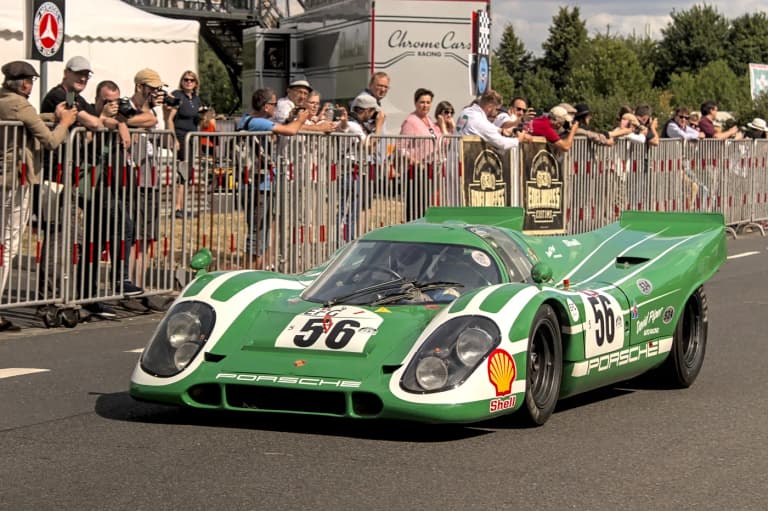
The Porsche 917 was the racing car that gave Porsche its first overall victory at the 24 Hours of Le Mans, in 1970. Powered by an air-cooled flat-12 designed by Hans Mezger, it dominated endurance racing and later, in turbocharged 917/30 form, produced over 1,100 horsepower in Can-Am. It is one of the most important and most valuable racing cars ever built, with a 917K once selling for more than 14 million dollars.
In this article, we’ll explain the Porsche 917, the race car that won Porsche’s first Le Mans overall victory. We’ll cover its flat-12 engine, the 917K and Langheck, and the 917/30.
Contents
What Is the Porsche 917
The Porsche 917 is the most significant racing car Porsche has ever built. It was a purpose-built endurance and sports prototype racer from the late 1960s and early 1970s, and it transformed Porsche from a class-winning underdog into an outright winner at the highest level of the sport.
Before the 917, Porsche had won countless class victories with cars like the 550 Spyder, beating larger machines on efficiency rather than power. The 917 was different. It was a no-compromise weapon built to win overall, against Ferrari, Ford, and everyone else.
It succeeded almost immediately, and in doing so it created the foundation of Porsche’s identity as a motorsport powerhouse. Every Porsche racing success that followed, including the 918 Spyder hypercar four decades later, traces back to the 917.
Built in Seven Months
The 917 was born from a change in the rules. New regulations for the World Sportscar Championship allowed 5.0-liter sports cars, provided a manufacturer built at least 25 examples for homologation. Porsche, under the direction of Ferdinand Piech, decided to seize the opportunity.
The result was a startling display of engineering will. Porsche designed and built the required 25 cars in roughly seven months. When inspectors arrived to verify the cars existed, Porsche lined all 25 up in the factory courtyard. It was an audacious commitment that left rivals stunned.
The Mezger Flat-12
At the heart of the 917 was an air-cooled flat-12 engine designed by Hans Mezger, the engineer whose name later became shorthand for Porsche’s greatest motorsport engines. It was effectively two flat-six units combined, mounted low in the chassis for a low center of gravity.
The engine started at 4.5 liters and around 520 horsepower in 1969. Over the next two seasons it grew to 4.9 and then 5.0 liters, with output climbing past 600 horsepower. For a car that weighed under 800 kilograms, this was a staggering amount of power, and it made the 917 brutally fast and famously intimidating in its early form.
Le Mans and the Racing Variants
The prize Porsche wanted most was overall victory at the 24 Hours of Le Mans. In 1970 it finally arrived. The number 23 917K, run by the Porsche Salzburg team in red and white, won through a rain-soaked race to give Porsche its first overall Le Mans win.
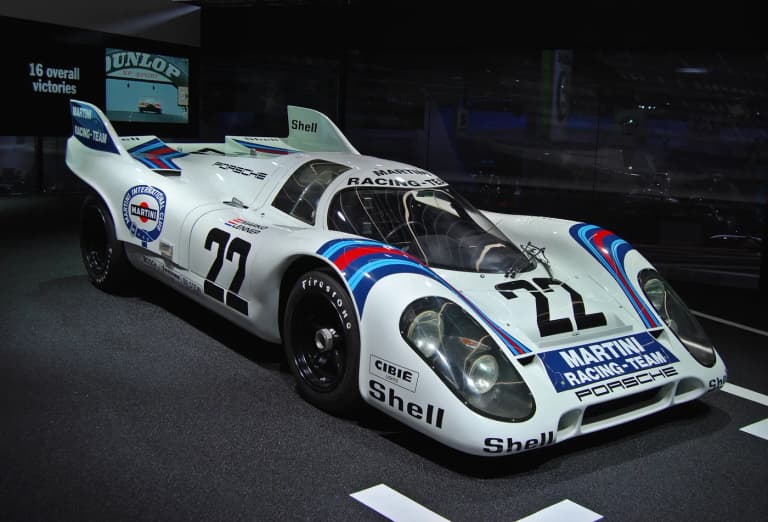
In 1971 the 917 won again, this time in the iconic Martini Racing colors seen above. That car set a distance record at Le Mans, covering more than 5,300 kilometers in 24 hours, a record that stood for nearly four decades. Two wins in two years confirmed the 917 as the dominant endurance car of its era.
917K Versus 917 Langheck
The early 917 had a serious problem: it was dangerously unstable at high speed. The original long-tail bodywork generated lift, making the car frightening to drive. The fix came from reshaping the rear into a shorter, upswept tail that created downforce instead.
This became the 917K, for Kurzheck, meaning short tail. It was vastly more stable and became the standard configuration for most races. For the very fast Le Mans circuit, Porsche also developed the 917 Langheck, or long tail, which traded some stability for a higher top speed down the long straights. The two body styles let Porsche tailor the car to each track.
Can-Am and the 917/30
When rule changes ended the 5.0-liter era in European endurance racing, Porsche took the 917 to North America and the unlimited Can-Am series. There, freed from displacement limits, the engine was turbocharged and the car evolved into the legendary 917/30.
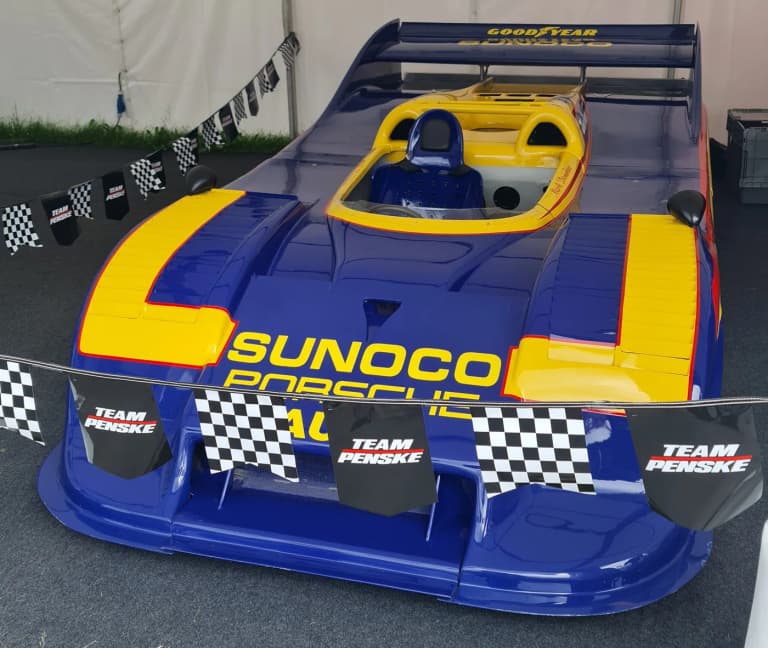
Developed with driver and engineer Mark Donohue for the Penske team, the turbocharged 917/30 produced over 1,100 horsepower in race trim and as much as 1,500 horsepower in qualifying tune. It was so utterly dominant that it effectively killed the Can-Am series, as no rival could come close. It remains one of the most powerful racing cars ever built.
Gulf, McQueen, and Pop Culture
The 917 escaped the racing world and became a genuine cultural icon. Much of that is down to the powder-blue and orange Gulf livery worn by the John Wyer team cars, one of the most recognized color schemes in all of motorsport.
The 917’s fame was sealed by Steve McQueen’s 1971 film “Le Mans,” which featured a Gulf 917 at its center and burned the car into popular memory. Decades later, the 917 still appears on posters, in video games, and in the dreams of enthusiasts who never saw it race.
Legacy and Values
The 917 established Porsche as a winner at the top of motorsport and created the engineering culture that produced every Porsche racing success since. Its flat-12, its aerodynamics work, and its turbocharging knowledge all fed directly into later cars like the 935, which dominated sports car racing through the 1970s and 1980s.
Genuine 917s almost never change hands, and when they do, they command astonishing prices. A 917K has sold for more than 14 million dollars, making it among the most valuable Porsches ever. These are not cars that trade on the open market so much as historic artifacts that occasionally surface. Values reflect documented race history above all else.
Frequently Asked Questions
Why is the Porsche 917 so famous?
The 917 gave Porsche its first overall victory at the 24 Hours of Le Mans in 1970, then won again in 1971. It dominated endurance racing, later produced over 1,100 horsepower in Can-Am form, and became a pop-culture icon through its Gulf livery and the Steve McQueen film “Le Mans.” It is widely regarded as the most important racing car Porsche ever built.
What engine does the Porsche 917 use?
The 917 uses an air-cooled flat-12 engine designed by Hans Mezger, essentially two flat-six units combined. It started at 4.5 liters and around 520 horsepower and grew to 5.0 liters and over 600 horsepower. The Can-Am 917/30 used a turbocharged version producing more than 1,100 horsepower.
What is the difference between the 917K and 917 Langheck?
The 917K, or Kurzheck, has a short upswept tail that creates downforce and high-speed stability, and it was used for most races. The 917 Langheck, or long tail, trades some stability for a higher top speed and was used at the very fast Le Mans circuit.
How powerful was the Porsche 917/30?
The turbocharged 917/30 Can-Am car produced over 1,100 horsepower in race trim and as much as 1,500 horsepower in qualifying tune. It was so dominant that it effectively ended the Can-Am series, and it remains one of the most powerful racing cars ever built.
How much is a Porsche 917 worth?
Genuine 917s are among the most valuable cars in the world. A 917K has sold for more than 14 million dollars. Because so few exist and they rarely come to market, values depend almost entirely on documented race history and originality.
How many Porsche 917s were built?
Porsche initially built 25 cars to meet homologation rules in 1969, assembling them in roughly seven months. Further examples and variants, including the long-tail Le Mans cars and the Can-Am 917/10 and 917/30, were built over the following seasons.
Images: Hero 917K by Alexander Migl, CC BY-SA 4.0. Martini 917K by Felix König, CC BY 3.0. Sunoco 917/30 by MrWalkr, CC BY-SA 4.0. Via Wikimedia Commons. Value figures are 2026 market estimates.