Quick answer: The Porsche 916 was a fixed-roof 914/6 prototype, not a normal production model. Porsche says it built eleven with 911 S or Carrera engines making 190 or 210 PS. It added a welded roof and flared bodywork, then was cancelled before production.
In this article, we’ll explain the Porsche 916, a rare fixed-roof prototype built from the 914/6. We’ll cover its 914/6 origins, flat-six engines, the eleven-car run, and provenance checks.
Contents
- 1 Quick Summary
- 2 Origins: Why Porsche Built the 916, and Its Relationship to the 914/6
- 3 Engine, Brakes, Wheels, and Chassis Specification
- 4 Bodywork: Fender Flares, Bumper Covers, and the Welded Steel Roof
- 5 The 1972 Porsche 916 Prototype Run and Why Porsche Cancelled It
- 6 Surviving Porsche 916 Prototype Chassis Numbers and Provenance
- 7 Its Place in Porsche History
- 8 Frequently Asked Questions
Quick Summary
- Production Total: 11 prototypes built in 1971 and 1972, including the first car nicknamed Brutus.
- Base Platform: Started from a 914/6 tub with a welded steel roof replacing the removable targa panel.
- Engine: The first three 1972 cars used the 2.4-liter 911 S flat-six, rated at 190 hp. Later cars used a 2.7-liter 911 Carrera flat-six, rated at 210 hp.
- Performance: 0 to 60 mph took under 7 seconds. No factory-verified top speed figure exists.
- Weight: About 165 lb lighter than a contemporary 911 S.
- Cancellation: Porsche cancelled the project about two weeks before its planned 1971 Paris Auto Salon debut. Projected pricing reached about DM 45,000, versus about DM 30,000 for a 911 S.
- Survival: All eleven prototypes are believed to survive today, several still within the Porsche and Piëch families.
Brutus, the first prototype, later received a separate racing-derived engine and does not match the production-intent figures above.
Origins: Why Porsche Built the 916, and Its Relationship to the 914/6
The Porsche 916 started with a modified 914 that finished sixth overall at Le Mans in 1970. That result convinced Porsche executive Ferdinand Piëch the car could handle more: a faster, more luxurious version for everyday driving as well as racing. Porsche also wanted a way to boost 914 sales and take on the Ferrari Dino 246, according to RM Sotheby’s chassis history.
The 914/6 needed that boost. In 1970 it cost $5,999 in the US, barely $500 less than a base 911 T. The four-cylinder 914 outsold it roughly 5 to 1 worldwide that year. By 1971 the gap had grown to nearly 37 to 1, according to Hemmings’ account of the car’s development. Porsche hoped a faster, more distinctive six-cylinder version could close that gap.
Piëch pulled a 914/6 chassis, number 9141430195, straight off the production line and had it modified for the project. He planned to use it as his daily driver and as a rolling testbed for the 916, according to Stuttcars.
The 916 was never its own model line. It started as a 914/6, the six-cylinder version of the standard 914. That version used a removable targa roof panel and Porsche’s own flat six instead of the smaller engine Volkswagen supplied for the base car. Porsche took that 914/6 tub, built by Karmann, and sent it to coachbuilder Baur for extensive modification, as the documented 0011 history describes.
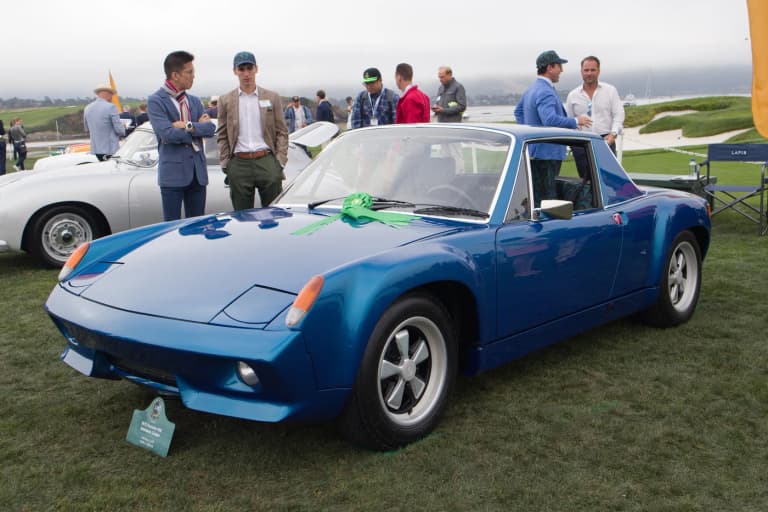
Baur welded in a steel roof panel in place of the 914/6’s removable plastic top. That changed the targa into a fixed-roof coupe for extra rigidity. Baur also added chassis and suspension reinforcement plates, as RM Sotheby’s build history details.
Engine, Brakes, Wheels, and Chassis Specification
Porsche planned a 2.6-liter flat six for the production 916. It was internally designated 911/56 for the US market and 911/86 for Europe. That engine never reached the ten 1972 production-intent prototypes, according to RM Sotheby’s specification record. Brutus, the earlier standalone prototype, did receive an early 2.6-liter unit before it was replaced.
The first three 1972 cars instead ran the 2.4-liter flat six from the 911 S, making 190 hp at 6,500 rpm. Later cars switched to a 2.7-liter unit from the 911 Carrera, making 210 hp, according to RM Sotheby’s records.
Published top-speed estimates vary, and no factory-backed record settles on one figure. Treat any precise top speed you see as an estimate, not a verified number.
Piëch’s original prototype, Brutus, was a different animal. Porsche first fitted it with a 2.6-liter flat six. It later received a modified 2.8-liter racing engine from the 911 RSR, according to Hemmings. The stock RSR version was rated at 308 hp and 217 lb-ft.
Piëch later had that engine enlarged to 2.9 liters and tuned to a reported 345 hp. Writer Basem Wasef described that version in the August 2018 issue of Porsche Panorama, as republished by Hemmings.
Period and collector accounts of its exact displacement and output vary. RM Sotheby’s lists a 2.9-liter, 245 bhp RSR engine, while the Porsche Panorama account above cites 345 hp for that same displacement.
RM Sotheby’s says the 916 weighed roughly 165 pounds less than a contemporary 911 S. It quotes a 0 to 60 mph time under 7 seconds for the 2.4-liter car.
Underneath, the 916 got the four-wheel vented disc brakes from the 911 S, front and rear anti-roll bars, stiffer springs, and Bilstein shocks. Porsche reinforced the floor and upgraded the suspension to handle the more powerful engine. These brake and chassis changes were as important as the extra output, per the lot’s specification record.
Bodywork: Fender Flares, Bumper Covers, and the Welded Steel Roof
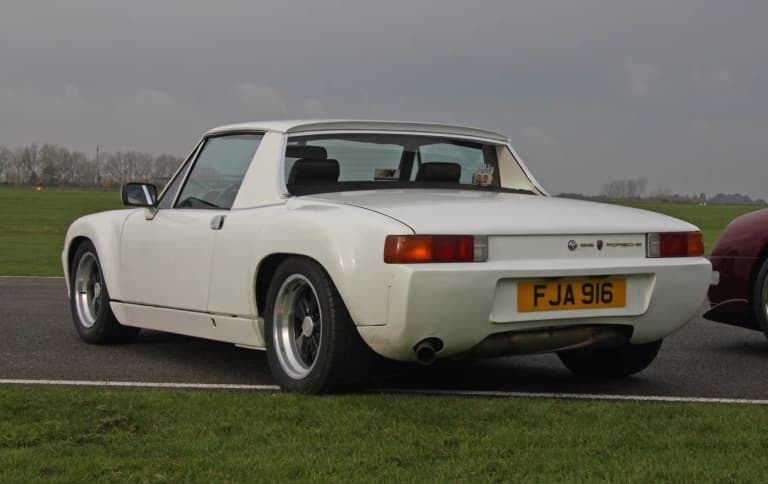
Beyond the roof, Baur fitted steel flares to the front and rear fenders, matching the wide-body look of the factory’s 914/6 GT race cars. Those flares made room for larger wheels: 7-inch Fuchs with wider tires than a standard 914 could take. Baur’s reinforcement and flare work later became the basis for the factory’s own “GT Sportkit” parts, according to RM Sotheby’s history of the car.
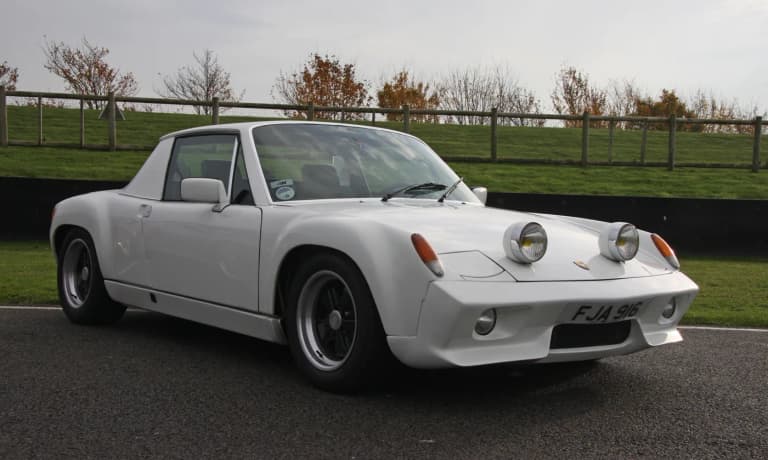
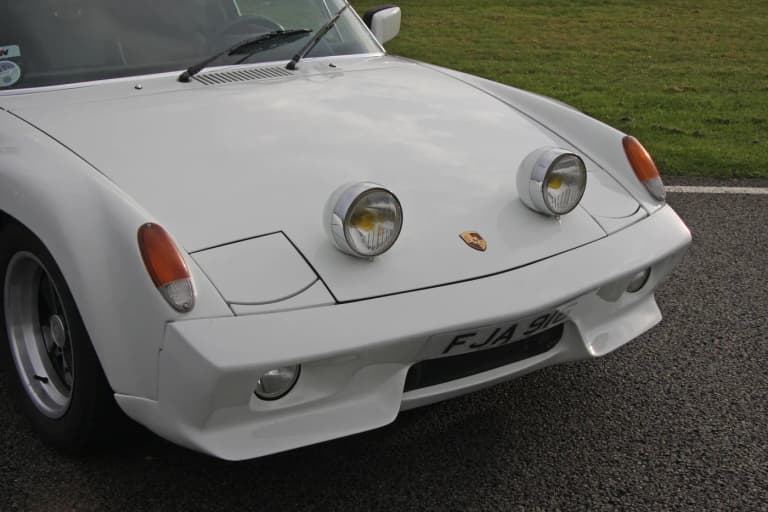
Both the front bumper cover and rear fascia were molded fiberglass, modeled directly on the 914/6 GT’s bodywork. The nose carried an integrated air dam with a lip spoiler and ducting for an extra oil radiator, flanked by recessed driving lamps. Porsche’s Design Studio had free rein over paint colors and interior trim. The cabin was also more sophisticated and better insulated than a standard 914’s, per RM Sotheby’s build description.
The 1972 Porsche 916 Prototype Run and Why Porsche Cancelled It
Brutus proved the concept, so Porsche greenlit ten more 916 prototypes, chassis numbers 9142330011 through 9142330020. Five went to Porsche management and friends of the company, and the rest were sold privately after the project ended. These were pre-production examples, not customer cars. Porsche had originally floated a production run of twenty to one hundred cars. It never came close, according to RM Sotheby’s account of the project.
The 916 was scheduled to debut at the 1971 Paris Auto Salon that October, badged as a 1972 model, according to Hemmings.
US price comparisons vary in period sources. The German price projection below gives a cleaner comparison against a contemporary 911 S.
About two weeks before that Paris debut, Porsche cancelled the whole project and halted production. Karmann supplied the finished bodywork, and Baur charged for the roof, flare, and reinforcement conversion. Together that pushed the projected German selling price to roughly DM 45,000, according to RM Sotheby’s. A 911 S cost around DM 30,000.
That combination made the 916 both the fastest car in Porsche’s lineup and its most expensive. Porsche judged that a production run at that price didn’t make financial sense. Ten pre-production examples were already finished or nearly done when the cancellation came.
Surviving Porsche 916 Prototype Chassis Numbers and Provenance
All eleven 916s are believed to survive today, and several stay within the Porsche and Piëch families, according to Hagerty. Other cars have moved through documented private sales and auctions.
Chassis 9142330011: The Piëch Family Car
One of the ten 1972 pre-production cars, chassis 9142330011, was built as a Privatwagen for Louise Piëch, a member of the Porsche-Piëch family. It was finished in Light Yellow (Hellgelb) with chestnut leather and corduroy seat inserts in a paisley pattern, unusual even by Porsche’s colorful early-1970s standards. Hagerty valuation analytics manager John Wiley documented that spec in the auction house’s coverage of the car’s 2020 sale.
Louise Piëch drove the car for about two years, then sold it to Porsche engineer Erna Götten. Götten sold it in 1979 to Los Angeles Times publisher and Porsche collector Otis Chandler for $30,000, according to RM Sotheby’s ownership record.
From there the car went to Japan before Dr. Thomas Gruber bought it in 2008 and completed a documented restoration. It sold at RM Sotheby’s 2020 auction for $957,000, against a Hagerty estimate of $900,000 to $1,000,000. That result reflects one sale, not current values.
Brutus’s Ownership Trail
Ferdinand Piëch’s own prototype, Brutus, has a separate and better-documented ownership trail. His wife, Corina, drove it after Ferdinand transferred to Audi in 1972. She reportedly coined the Brutus nickname for the car’s aggressive looks, not its performance. Her name is engraved in gold script on the glovebox door. She sold the car in April 1974 to an American serviceman, Colonel Robert E. Hartvigsen, for 27,500 Deutschmarks, then about $10,700, according to Hemmings.
Porsche’s Zuffenhausen factory rebuilt its engine, transaxle, and suspension in late 1977, and Hartvigsen shipped it back to the US in 1978. He kept the car for the rest of his life. Hemmings documents its later discovery and three-year restoration.
Brutus made its public re-debut at the 2017 Amelia Island Concours d’Elegance. It sold at Artcurial’s Rétromobile auction in February 2019 for a fee-inclusive €953,600, then about $1.08 million. Hemmings called it a model record at the time.
Not every 916 stayed in Europe or in family hands. One of the ten 1972 prototypes went new to Peter Gregg, the Brumos Porsche owner and factory-backed racer. Porsche fitted it with air conditioning for Florida’s climate, according to the same Hemmings account.
The 916 was never a catalogued production car, so appearance alone can’t authenticate one. Before you take a 916 seriously, verify three things:
- Chassis and factory records: Match the chassis number to Porsche’s Kardex and the documented prototype sequence.
- Construction and mechanical condition: Get a full mechanical inspection rather than trusting badges. Check the welded roof panel, fender work, reinforced floor, suspension, brakes, engine, and transaxle.
- Ownership history: Confirm the current owner has clear title. Trace prior owners, restoration records, photographs, and auction documents before you treat the car’s story or sale history as proven.
Its Place in Porsche History
Porsche’s own account counts eleven cars: Brutus plus the ten 1972 prototypes carrying chassis numbers 9142330011 through 9142330020, according to Stuttcars’ chassis sequence. That figure also matches Porsche’s published company history. Broader enthusiast and market sources sometimes cite twelve 916s, but that number doesn’t match the documented sequence, and the factory record doesn’t back it up.
The 916 never reached production, and Porsche wouldn’t return to a 914/6-style mid-engine six-cylinder road car for decades. Some historians argue the 916’s engineering fed into the 911 Carrera RS 2.7 that followed in 1973. That link is a matter of interpretation, not a documented factory decision.
Either way, the 916 is a rare case of Porsche building a small, hand-finished derivative. It tested how far the 914 platform could be pushed before the numbers said no.
Frequently Asked Questions
What is a Porsche 916?
The Porsche 916 was a fixed-roof, higher-performance development of the 914/6, built as a small prototype series rather than a regular production model. Porsche’s own account puts the total at eleven cars, built in 1971 and 1972 before the project was cancelled.
How many Porsche 916s were built?
Porsche’s factory history states eleven 916s were built: the first prototype, nicknamed Brutus, plus ten further 1972-model cars. Some enthusiast and market write-ups cite twelve, but the chassis-number sequence and Porsche’s own account support eleven.
What is the difference between a Porsche 914/6 and a 916?
The 914/6 kept the standard 914’s removable targa roof panel and 2.0-liter flat six. The 916 started from a 914/6 body but received a welded steel roof, flared fenders, and reinforced suspension. A larger 2.4-liter or 2.7-liter flat six came from the 911 S or Carrera.
Why did Porsche cancel the 916?
Porsche cancelled the 916 about two weeks before its planned debut at the 1971 Paris Auto Salon. Sourcing the body from Karmann and the conversion work from Baur pushed the projected retail price well past a 911 S. Porsche judged that the small production run could not cover that cost.
What engine did the Porsche 916 use?
The first three 1972 prototypes used the 2.4-liter flat six from the 911 S, rated at 190 hp. The remaining cars used a 2.7-liter flat six from the 911 Carrera, rated at 210 hp. The first prototype, Brutus, ran a separate, more powerful racing-derived engine.
Related reading: the Porsche 914 guide covers the 914/4 and 914/6. The Porsche 901 guide covers the car that started the 911 line. The classic 911 guide covers the models that supplied the 916’s engines.
Images: 1972 Porsche 916 at Pebble Beach Concours 2023 by Prova MO, CC BY-SA 4.0. Side, rear, and front-detail views by Brian Snelson: side view, rear view, and front detail, each CC BY 2.0. Via Wikimedia Commons.