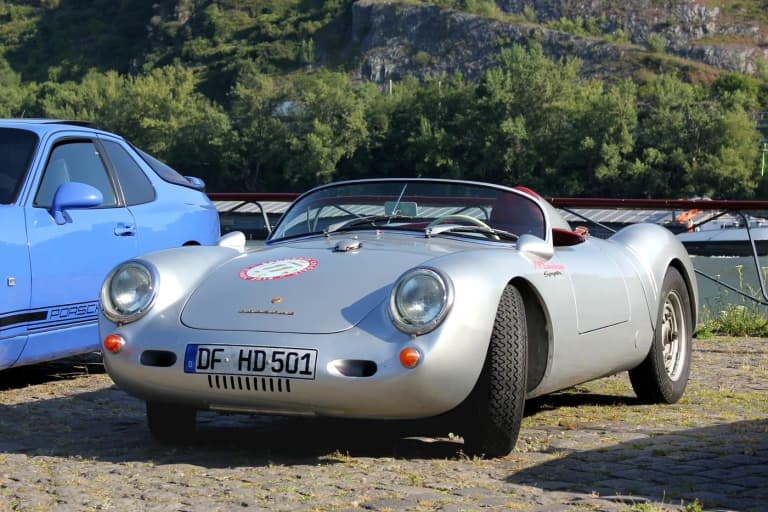
The Porsche 550 Spyder was Porsche’s first purpose-built racing car, produced from 1953 to 1956. It was a tiny, lightweight, mid-engined roadster powered by the complex Type 547 four-cam flat-four, and it earned the nickname “giant killer” for beating far larger cars in its class. Only about 90 were built, one of which was James Dean’s, and survivors now sell for several million dollars.
In this article, we’ll explain the Porsche 550 Spyder’s history and racing legacy. We’ll cover four-cam engine, racing history, James Dean story, and values.
Contents
What Is the Porsche 550 Spyder
The Porsche 550 Spyder was the first car Porsche designed specifically to go racing. The earlier 356 had competed successfully, but it was a road car adapted for the track. The 550 was the opposite: a pure competition machine, with road registration almost an afterthought.
It was small, low, and astonishingly light, weighing around 590 kilograms. The engine sat in the middle of the car, ahead of the rear axle, for the best possible weight distribution. This mid-engine layout was unusual for Porsche at the time and pointed toward the company’s future racing cars.
Where the 550 made its name was the relationship between its modest 1.5-liter engine and its featherweight body. It did not have the outright power of larger sports racers, but it could embarrass them through corners and over a full race distance. That is how it earned the “giant killer” reputation.
History, the Fuhrmann Engine, and the 550A
Porsche developed the 550 in the early 1950s to contest the 1.1- and 1.5-liter classes in international sports car racing. The project grew out of privateer specials built around 356 mechanicals, which showed the company how competitive a light, low Porsche could be.
The factory cars used an open roadster body, a tubular chassis, and a mid-mounted flat-four. From its earliest outings the 550 was a class winner, and it quickly became the car to beat in the small-displacement categories at events across Europe and the Americas.
The Four-Cam Fuhrmann Engine
The heart of the 550 is the Type 547 engine, designed by Dr. Ernst Fuhrmann. It is an air-cooled flat-four with double overhead camshafts on each bank, driven by a complex arrangement of vertical shafts and bevel gears. Enthusiasts simply call it the four-cam.
In 1.5-liter form the four-cam produced around 110 horsepower, an enormous output per liter for the mid-1950s. The trade-off was complexity. Setting up the valve timing on a four-cam reportedly took a skilled mechanic many hours, and the engine demanded constant attention. The same engine, in detuned form, powered the road-going 356 Carrera.
That four-cam engine is the thread that connects the 550 to the modern Porsche range. The “Carrera” name that Porsche later applied to the 356 Carrera, and eventually to the entire 911 line, came from the car’s success in the Carrera Panamericana road race.
The 550 A and the Spaceframe
In 1956 Porsche introduced the 550 A. Its key advance was a true tubular spaceframe chassis, which was significantly lighter and stiffer than the simpler ladder frame of the original car. The 550 A also improved the rear suspension for better handling at the limit.
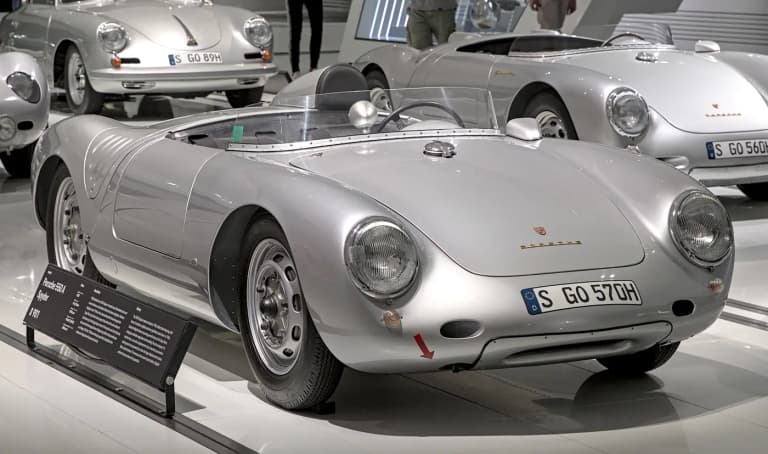
The 550 A delivered Porsche one of its most famous early results. At the 1956 Targa Florio, Umberto Maglioli drove a 550 A to an outright victory, beating much larger and more powerful machinery over the brutal Sicilian road course. It was a landmark win that proved the giant-killer concept on the biggest stage.
The Giant Killer on Track
The 550 and 550 A racked up class wins at Le Mans, the Nurburgring, Sebring, and the Carrera Panamericana, along with the outright Targa Florio victory. The formula was always the same: keep the weight down, keep the car reliable, and let the larger cars wear themselves out.
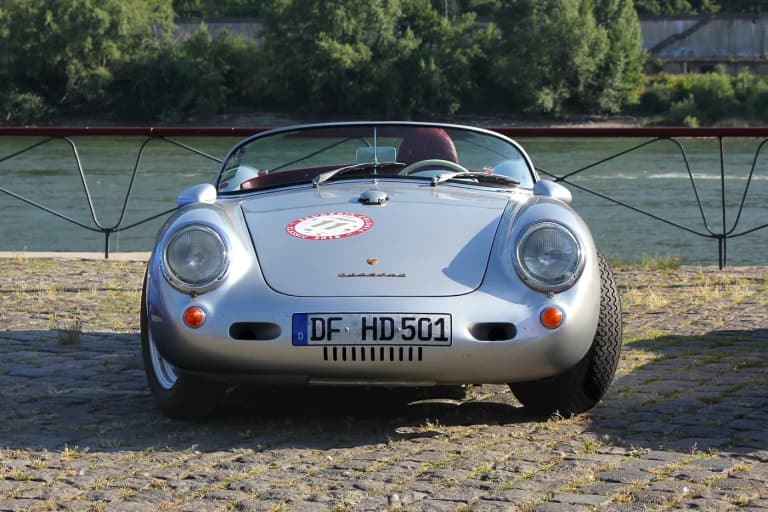
This racing record mattered far beyond the trophies. It established Porsche as a serious motorsport manufacturer and built the engineering culture, lightweight and efficient rather than brute-force, that still defines the brand. The 550 led directly to the 718 RSK and the long line of Porsche sports racers that followed.
The James Dean Story
The 550 Spyder is famous beyond car circles because of the actor James Dean. In September 1955 Dean bought a new 550 Spyder, had it numbered 130, and nicknamed it “Little Bastard.” On 30 September 1955, while driving to a race in California, he was killed in a collision at a highway junction.
Dean’s death at the age of 24 turned his 550 into one of the most mythologized cars in history. Stories about the wreck and its scattered parts grew into a full-blown curse legend over the following decades. The car itself disappeared, and its whereabouts remain unknown, which only deepened the mystery.
The association is a double-edged thing. It made the 550 a cultural icon recognized far outside Porsche enthusiast circles, but it also overshadows what the car actually was: a brilliant, successful little racing machine that earned its fame on the track first.
Legacy and the Spyder Name
The 550 established two ideas that Porsche still trades on. The first is the mid-engine racing layout that runs through the 718 RSK, the 904, and eventually the modern mid-engine sports cars. The second is the “Spyder” name itself, which Porsche has revived repeatedly on lightweight, open, driver-focused models.
The Carrera name has an even broader legacy. Born from the four-cam engine’s success in Mexico, it spread from the 356 Carrera to become the core name of the 911 range, where it remains today. Few single cars have left as deep a mark on a company’s identity as the 550.
Values and Collectibility
With only around 90 cars built and a competition history this significant, the 550 sits at the very top of the Porsche collector market. Genuine factory cars rarely come up for sale, and when they do, they trade for several million dollars.
| Car | Status | Approx. Value |
|---|---|---|
| 550 / 550 A (genuine) | Documented race history | $3,000,000 to $6,000,000+ |
| 550 (lesser history) | Authenticated, period car | $2,000,000 to $4,000,000 |
| Replica / recreation | Modern build | $30,000 to $90,000 |
Because genuine cars are so rare and valuable, a large industry of 550 replicas exists, built on tube frames with air-cooled flat-four power. These offer the look and much of the experience for a tiny fraction of the price, but they are not to be confused with the real thing. Values shown are 2026 estimates and depend heavily on documented provenance.
Frequently Asked Questions
How many Porsche 550 Spyders were built?
Porsche built approximately 90 examples of the 550 and 550 A between 1953 and 1956. That small number, combined with the car’s significant racing history, makes it one of the rarest and most valuable Porsches ever produced.
Why is the Porsche 550 called the giant killer?
The 550 had only a 1.5-liter engine producing around 110 horsepower, but it weighed about 590 kilograms. Its light weight and excellent handling let it beat much larger and more powerful sports cars, especially over a full race distance. That is how it earned the giant-killer nickname.
What engine does the Porsche 550 Spyder use?
The 550 uses the Type 547 four-cam engine designed by Ernst Fuhrmann. It is an air-cooled flat-four with double overhead camshafts on each bank, producing around 110 horsepower from 1.5 liters. The same engine, detuned, powered the road-going 356 Carrera.
What happened to James Dean’s Porsche 550 Spyder?
James Dean was killed in his 550 Spyder, nicknamed “Little Bastard,” in a collision in California on 30 September 1955. The wrecked car later disappeared and its whereabouts remain unknown, which helped build the famous curse legend around it.
How much is a Porsche 550 Spyder worth?
Genuine factory 550 and 550 A cars with documented history trade for several million dollars, often in the $3,000,000 to $6,000,000 range. Modern replicas, which are common, sell for a small fraction of that, typically between $30,000 and $90,000.
Was the 550 Spyder a mid-engine car?
Yes. The 550 placed its flat-four engine in front of the rear axle, in the middle of the car, for ideal weight distribution. This mid-engine layout was central to its handling advantage and influenced Porsche’s later sports racers.
Images: Hero 550 Spyder by Lothar Spurzem, CC BY-SA 2.0 DE. 550 A in the Porsche Museum by Alexander Migl, CC BY-SA 4.0. 550 A front view by Lothar Spurzem, CC BY-SA 2.0 DE. Via Wikimedia Commons. Value figures are 2026 market estimates and vary with provenance.